

-
1 Stromleiter
токопровод
Устройство, выполненное в виде шин или проводов с изоляторами и поддерживающими конструкциями, предназначенное для передачи и распределения электрической энергии в пределах электростанции, подстанции или цеха.
[ ГОСТ 24291-90]
токопровод
Электрическая проводка со всеми относящимися к ней элементами и конструкциями для передачи электроэнергии к потребителям
[Терминологический словарь по строительству на 12 языках (ВНИИИС Госстроя СССР)]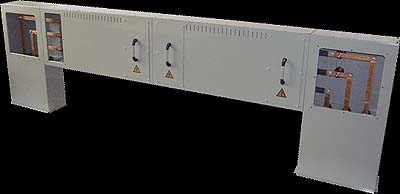
Токопровод
[http://terma-energo.ru/products/Tokoprovody/]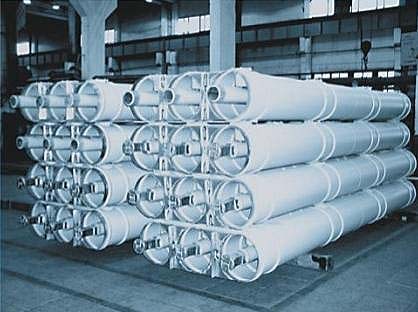
[http://open.gisprofi.ru/providercatalog/viewCatalog/58/]Токопроводы применяются как высоковольтные электрические аппараты среднего или высокого напряжения в электрических соединениях на напряжение от 6 до 35 кВ включительно, а шинопроводы применяются как низковольтные электрические аппараты на напряжение от 0,4 до 1,2 кВ.
Токопроводы для электрического соединения трехфазного переменного тока генераторов с повышающими блочными силовыми трансформаторами, также с силовыми трансформаторами собственных нужд и другими электрическими аппаратами главной цепи ТЭЦ, ГРЭС, АЭС называются токопроводами генераторного напряжения.
Токопроводы для электрического соединения трехфазного переменного тока силовых трансформаторов собственных нужд на электростанциях со стороны напряжения 6-10 кВ со шкафами комплектных распределительных устройств называются токопроводами собственных нужд.
По конструктивному исполнению токопроводы подразделяются:- на пофазно-экранированные токопроводы с непрерывным экраном и с компенсированным внешним электромагнитным полем для генераторов ТЭЦ, ГРЭС, ГЭС и АЭС
- токопроводы с общей для трех фаз из алюминия или стали оболочкой с разделительной перегородкой или без нее.
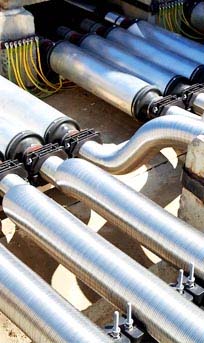
Токопроводы
[http://www.tokoprovod.ru/albom_2.php]Примечание.
Токопроводы напряжением до 1 кВ с жесткими шинами заводского изготовления, поставляемые комплектно на место монтажа, называют шинопроводами.
[http://www.naxso.ru/promo/?id=3]Тематики
Близкие понятия
Сопутствующие термины
- пофазно-экранированные токопроводы
- токопроводы с общей для трех фаз оболочкой
- токопроводы с общей для трех фаз оболочкой с разделительной перегородкой
EN
DE
FR
Немецко-русский словарь нормативно-технической терминологии > Stromleiter
-
2 Hochspannungsgleichstromkabel
n <el> ■ high-voltage direct current cableGerman-english technical dictionary > Hochspannungsgleichstromkabel
-
3 Speiseleitungstrommel
Deutsch-Englisch Wörterbuch Engineering > Speiseleitungstrommel
-
4 Steuerleitungstrommel
Deutsch-Englisch Wörterbuch Engineering > Steuerleitungstrommel
-
5 Schwachstromkabel
Schwachstromkabel EL weak-current cableDeutsch-Englisch Fachwörterbuch Architektur und Bauwesen > Schwachstromkabel
-
6 Schwachstromkabel
Schwachstromkabel n weak-current cableDeutsch-Englisch Wörterbuch der Elektrotechnik und Elektronik > Schwachstromkabel
-
7 Dauerstrombelastbarkeit, f
(длительный) допустимый ток
Максимальное значение электрического тока, который может протекать длительно по проводнику, устройству или аппарату при определенных условиях без превышения определенного значения их температуры в установившемся режиме
[ ГОСТ Р МЭК 60050-826-2009]
Этот ток обозначают IZ
[ ГОСТ Р 50571. 1-2009 ( МЭК 60364-1: 2005)]EN
(continuous) current-carrying capacity
ampacity (US)
maximum value of electric current which can be carried continuously by a conductor, a device or an apparatus, under specified conditions without its steady-state temperature exceeding a specified value
[IEV number 826-11-13]
ampacity
The current in amperes that a conductor can carry continuously under the conditions of use without exceeding its temperature rating.
[National Electrical Cod]FR
courant (permanent) admissible, m
valeur maximale du courant électrique qui peut parcourir en permanence, un conducteur, un dispositif ou un appareil, sans que sa température de régime permanent, dans des conditions données, soit supérieure à la valeur spécifiée
[IEV number 826-11-13]Ampacity, the term is defined as the maximum amount of current a cable can carry before sustaining immediate or progressive deterioration. Also described as current rating or current-carrying capacity, is the RMS electric current which a device can continuously carry while remaining within its temperature rating. The ampacity of a cable depends on:
- its insulation temperature rating;
- conductor electrical properties for current;
- frequency, in the case of alternating currents;
- ability to dissipate heat, which depends on cable geometry and its surroundings;
- ambient temperature.
Electric wires have some resistance, and electric current flowing through them causes voltage drop and power dissipation, which heats the cable. Copper or aluminum can conduct a large amount of current before melting, but long before the conductors melt, their insulation would be damaged by the heat.
The ampacity for a power cable is thus based on physical and electrical properties of the material & construction of the conductor and of its insulation, ambient temperature, and environmental conditions adjacent to the cable. Having a large overall surface area may dissipate heat well if the environment can absorb the heat.
In a long run of cable, different conditions govern, and installation regulations normally specify that the most severe condition along the run governs the cable's rating. Cables run in wet or oily locations may carry a lower temperature rating than in a dry installation. Derating is necessary for multiple circuits in close proximity. When multiple cables are near, each contributes heat to the others and diminishes the amount of cooling air that can flow past the individual cables. The overall ampacity of the insulated conductors in a bundle of more than 3 must be derated, whether in a raceway or cable. Usually the de-rating factor is tabulated in a nation's wiring regulations.
Depending on the type of insulating material, common maximum allowable temperatures at the surface of the conductor are 60, 75 and 90 degrees Celsius, often with an ambient air temperature of 30°C. In the U.S., 105°C is allowed with ambient of 40°C, for larger power cables, especially those operating at more than 2 kV. Likewise, specific insulations are rated 150, 200 or 250°C.
The allowed current in cables generally needs to be decreased (derated) when the cable is covered with fireproofing material.
For example, the United States National Electric Code, Table 310-16, specifies that up to three 8 AWG copper wires having a common insulating material (THWN) in a raceway, cable, or direct burial has an ampacity of 50 A when the ambient air is 30°C, the conductor surface temperature allowed to be 75°C. A single insulated conductor in air has 70 A rating.
Ampacity rating is normally for continuous current, and short periods of overcurrent occur without harm in most cabling systems. The acceptable magnitude and duration of overcurrent is a more complex topic than ampacity.
When designing an electrical system, one will normally need to know the current rating for the following:- Wires
- Printed Circuit Board traces, where included
- Fuses
- Circuit breakers
- All or nearly all components used
Some devices are limited by power rating, and when this power rating occurs below their current limit, it is not necessary to know the current limit to design a system. A common example of this is lightbulb holders.
[http://en.wikipedia.org/wiki/Ampacity]
Тематики
- электротехника, основные понятия
Синонимы
EN
DE
- Dauerstrombelastbarkeit, f
- Strombelastbarkeit, f
FR
- courant admissible, m
- courant permanent admissible, m
Немецко-русский словарь нормативно-технической терминологии > Dauerstrombelastbarkeit, f
-
8 Strombelastbarkeit, f
(длительный) допустимый ток
Максимальное значение электрического тока, который может протекать длительно по проводнику, устройству или аппарату при определенных условиях без превышения определенного значения их температуры в установившемся режиме
[ ГОСТ Р МЭК 60050-826-2009]
Этот ток обозначают IZ
[ ГОСТ Р 50571. 1-2009 ( МЭК 60364-1: 2005)]EN
(continuous) current-carrying capacity
ampacity (US)
maximum value of electric current which can be carried continuously by a conductor, a device or an apparatus, under specified conditions without its steady-state temperature exceeding a specified value
[IEV number 826-11-13]
ampacity
The current in amperes that a conductor can carry continuously under the conditions of use without exceeding its temperature rating.
[National Electrical Cod]FR
courant (permanent) admissible, m
valeur maximale du courant électrique qui peut parcourir en permanence, un conducteur, un dispositif ou un appareil, sans que sa température de régime permanent, dans des conditions données, soit supérieure à la valeur spécifiée
[IEV number 826-11-13]Ampacity, the term is defined as the maximum amount of current a cable can carry before sustaining immediate or progressive deterioration. Also described as current rating or current-carrying capacity, is the RMS electric current which a device can continuously carry while remaining within its temperature rating. The ampacity of a cable depends on:
- its insulation temperature rating;
- conductor electrical properties for current;
- frequency, in the case of alternating currents;
- ability to dissipate heat, which depends on cable geometry and its surroundings;
- ambient temperature.
Electric wires have some resistance, and electric current flowing through them causes voltage drop and power dissipation, which heats the cable. Copper or aluminum can conduct a large amount of current before melting, but long before the conductors melt, their insulation would be damaged by the heat.
The ampacity for a power cable is thus based on physical and electrical properties of the material & construction of the conductor and of its insulation, ambient temperature, and environmental conditions adjacent to the cable. Having a large overall surface area may dissipate heat well if the environment can absorb the heat.
In a long run of cable, different conditions govern, and installation regulations normally specify that the most severe condition along the run governs the cable's rating. Cables run in wet or oily locations may carry a lower temperature rating than in a dry installation. Derating is necessary for multiple circuits in close proximity. When multiple cables are near, each contributes heat to the others and diminishes the amount of cooling air that can flow past the individual cables. The overall ampacity of the insulated conductors in a bundle of more than 3 must be derated, whether in a raceway or cable. Usually the de-rating factor is tabulated in a nation's wiring regulations.
Depending on the type of insulating material, common maximum allowable temperatures at the surface of the conductor are 60, 75 and 90 degrees Celsius, often with an ambient air temperature of 30°C. In the U.S., 105°C is allowed with ambient of 40°C, for larger power cables, especially those operating at more than 2 kV. Likewise, specific insulations are rated 150, 200 or 250°C.
The allowed current in cables generally needs to be decreased (derated) when the cable is covered with fireproofing material.
For example, the United States National Electric Code, Table 310-16, specifies that up to three 8 AWG copper wires having a common insulating material (THWN) in a raceway, cable, or direct burial has an ampacity of 50 A when the ambient air is 30°C, the conductor surface temperature allowed to be 75°C. A single insulated conductor in air has 70 A rating.
Ampacity rating is normally for continuous current, and short periods of overcurrent occur without harm in most cabling systems. The acceptable magnitude and duration of overcurrent is a more complex topic than ampacity.
When designing an electrical system, one will normally need to know the current rating for the following:- Wires
- Printed Circuit Board traces, where included
- Fuses
- Circuit breakers
- All or nearly all components used
Some devices are limited by power rating, and when this power rating occurs below their current limit, it is not necessary to know the current limit to design a system. A common example of this is lightbulb holders.
[http://en.wikipedia.org/wiki/Ampacity]
Тематики
- электротехника, основные понятия
Синонимы
EN
DE
- Dauerstrombelastbarkeit, f
- Strombelastbarkeit, f
FR
- courant admissible, m
- courant permanent admissible, m
Немецко-русский словарь нормативно-технической терминологии > Strombelastbarkeit, f
-
9 Strom
m; -(e)s, Ströme2. von Luft, Lava, Blut, Tränen, Menschen, Verkehr etc.: stream; stärker: torrent; endloser Strom von Menschen, Verkehr etc.: endless stream; Strom von Worten flood of words; in Strömen fließen Sekt etc.: flow like water; es gießt in Strömen it’s pouring3. (Strömung) current (auch fig.); mit dem / gegen den Strom schwimmen swim with / against the current (fig. tide); fig. auch go with / against the flow4. ETECH. (electric) current; weitS. (Elektrizität) electricity; (Stromzufuhr) auch power (supply), electricity supply; grüner Strom green electricity (not produced in a nuclear power station); der Strom fiel aus there was a power failure; der Strom wird abgeschaltet the electricity is (being cut) off, we are having a power cut; Strom führendes oder unter Strom stehendes Kabel live wire ( größer: cable); unter Strom stehen Kabel etc.: be live; dauernd unter Strom stehen fig. be constantly on the go; Strom sparend power-saving* * *der Strom(Elektrizität) juice; electric current; current; power;(Gewässer) torrent; river; stream;(Schwall) gush; volley; stream;(Strömung) current; stream* * *[ʃtroːm]m -(e)s, -e['ʃtrøːmə]1) (large) river; (= Strömung) current; (von Schweiß, Blut) river; (von Besuchern, Flüchen etc) streamein reißender Stróm — a raging torrent
ein Stróm von Tränen (geh) — floods of tears pl
in dem or im Stróm der Vergessenheit versinken (geh) — to sink or pass into oblivion
der Stróm seiner Rede (geh) — the torrent or flood of his words
der Stróm der Zeit (geh) — the flow of time
der Stróm der Geschichte (geh) — the course of history
mit dem/gegen den Stróm schwimmen (lit) — to swim with/against the current; (fig) to swim or go with/against the tide
2) (ELEC)(elektrischer) Stróm — current
Stróm führen — to be live
Stróm führend (Elec, Leitung) — live
unter Stróm stehen (lit) — to be live; (fig) to be high (inf)
mit Stróm heizen — to have electric heating
der Stróm ist ausgefallen — the power or electricity is off
* * *der1) ((a) flow of electricity: an electrical current.) current2) (a flow of eg water, air etc: A stream of water was pouring down the gutter; A stream of people was coming out of the cinema; He got into the wrong stream of traffic and uttered a stream of curses.) stream3) (the current of a river etc: He was swimming against the stream.) stream* * *Strom1<-[e]s, Ströme>[ʃtro:m, pl ˈʃtrø:mə]\Strom führen to be liveelektrischer \Strom electric current\Strom führend liveunter \Strom stehen (elektrisch geladen sein) to be live; (überaus aktiv sein) to be a live wire fig famStrom2<-[e]s, Ströme>[ʃtro:m, pl ˈʃtrø:mə]m1. (großer Fluss) [large] river2. (fließende Menge) riverStröme von Blut rivers of bloodein \Strom von Schlamm a torrent of mudin Strömen fließen to flow freely [or like water]das Blut floss in Strömen there were rivers of blood, there was heavy bloodshed3. (Schwarm) streamStröme von Fans/Besuchern/Kunden streams of fans/visitors/customers4.▶ in Strömen gießen [o regnen] to pour [down] [with rain]▶ mit dem/gegen den \Strom schwimmen to swim with/against the current, to swim with/against the tide [or go with/against the flow] fig fam* * *der; Strom[e]s, Ströme1) river; (von Blut, Schweiß, Wasser, fig.): (Erinnerungen, Menschen, Autos usw.) streamin Strömen regnen od. (ugs.) gießen — pour with rain
in Strömen fließen — (fig.) flow freely
das Blut floss in Strömen — (fig.) there was heavy bloodshed
2) (Strömung) currentmit dem/gegen den Strom schwimmen — (fig.) swim with/against the tide (fig.)
3) (Elektrizität) current; (Stromversorgung) electricitydas Kabel führt od. steht unter Strom — the cable is live
* * *1. (Fluss) (large) river;reißender Strom raging torrentendloser Strom von Menschen, Verkehr etc: endless stream;Strom von Worten flood of words;in Strömen fließen Sekt etc: flow like water;es gießt in Strömen it’s pouringmit dem/gegen den Strom schwimmen swim with/against the current (fig tide); fig auch go with/against the flow4. ELEK (electric) current; weitS. (Elektrizität) electricity; (Stromzufuhr) auch power (supply), electricity supply;grüner Strom green electricity (not produced in a nuclear power station);der Strom fiel aus there was a power failure;der Strom wird abgeschaltet the electricity is (being cut) off, we are having a power cut;unter Strom stehendes Kabel live wire ( größer: cable);unter Strom stehen Kabel etc: be live;dauernd unter Strom stehen fig be constantly on the go;Strom sparend power-saving* * *der; Strom[e]s, Ströme1) river; (von Blut, Schweiß, Wasser, fig.): (Erinnerungen, Menschen, Autos usw.) streamin Strömen regnen od. (ugs.) gießen — pour with rain
in Strömen fließen — (fig.) flow freely
das Blut floss in Strömen — (fig.) there was heavy bloodshed
2) (Strömung) currentmit dem/gegen den Strom schwimmen — (fig.) swim with/against the tide (fig.)
3) (Elektrizität) current; (Stromversorgung) electricitydas Kabel führt od. steht unter Strom — the cable is live
* * *¨-e m.current n.electricity n.flow n.flush n.gush n.power n.stream n. -
10 strom
m; -(e)s, Ströme2. von Luft, Lava, Blut, Tränen, Menschen, Verkehr etc.: stream; stärker: torrent; endloser Strom von Menschen, Verkehr etc.: endless stream; Strom von Worten flood of words; in Strömen fließen Sekt etc.: flow like water; es gießt in Strömen it’s pouring3. (Strömung) current (auch fig.); mit dem / gegen den Strom schwimmen swim with / against the current (fig. tide); fig. auch go with / against the flow4. ETECH. (electric) current; weitS. (Elektrizität) electricity; (Stromzufuhr) auch power (supply), electricity supply; grüner Strom green electricity (not produced in a nuclear power station); der Strom fiel aus there was a power failure; der Strom wird abgeschaltet the electricity is (being cut) off, we are having a power cut; Strom führendes oder unter Strom stehendes Kabel live wire ( größer: cable); unter Strom stehen Kabel etc.: be live; dauernd unter Strom stehen fig. be constantly on the go; Strom sparend power-saving* * *der Strom(Elektrizität) juice; electric current; current; power;(Gewässer) torrent; river; stream;(Schwall) gush; volley; stream;(Strömung) current; stream* * *[ʃtroːm]m -(e)s, -e['ʃtrøːmə]1) (large) river; (= Strömung) current; (von Schweiß, Blut) river; (von Besuchern, Flüchen etc) streamein reißender Stróm — a raging torrent
ein Stróm von Tränen (geh) — floods of tears pl
in dem or im Stróm der Vergessenheit versinken (geh) — to sink or pass into oblivion
der Stróm seiner Rede (geh) — the torrent or flood of his words
der Stróm der Zeit (geh) — the flow of time
der Stróm der Geschichte (geh) — the course of history
mit dem/gegen den Stróm schwimmen (lit) — to swim with/against the current; (fig) to swim or go with/against the tide
2) (ELEC)(elektrischer) Stróm — current
Stróm führen — to be live
Stróm führend (Elec, Leitung) — live
unter Stróm stehen (lit) — to be live; (fig) to be high (inf)
mit Stróm heizen — to have electric heating
der Stróm ist ausgefallen — the power or electricity is off
* * *der1) ((a) flow of electricity: an electrical current.) current2) (a flow of eg water, air etc: A stream of water was pouring down the gutter; A stream of people was coming out of the cinema; He got into the wrong stream of traffic and uttered a stream of curses.) stream3) (the current of a river etc: He was swimming against the stream.) stream* * *Strom1<-[e]s, Ströme>[ʃtro:m, pl ˈʃtrø:mə]\Strom führen to be liveelektrischer \Strom electric current\Strom führend liveunter \Strom stehen (elektrisch geladen sein) to be live; (überaus aktiv sein) to be a live wire fig famStrom2<-[e]s, Ströme>[ʃtro:m, pl ˈʃtrø:mə]m1. (großer Fluss) [large] river2. (fließende Menge) riverStröme von Blut rivers of bloodein \Strom von Schlamm a torrent of mudin Strömen fließen to flow freely [or like water]das Blut floss in Strömen there were rivers of blood, there was heavy bloodshed3. (Schwarm) streamStröme von Fans/Besuchern/Kunden streams of fans/visitors/customers4.▶ in Strömen gießen [o regnen] to pour [down] [with rain]▶ mit dem/gegen den \Strom schwimmen to swim with/against the current, to swim with/against the tide [or go with/against the flow] fig fam* * *der; Strom[e]s, Ströme1) river; (von Blut, Schweiß, Wasser, fig.): (Erinnerungen, Menschen, Autos usw.) streamin Strömen regnen od. (ugs.) gießen — pour with rain
in Strömen fließen — (fig.) flow freely
das Blut floss in Strömen — (fig.) there was heavy bloodshed
2) (Strömung) currentmit dem/gegen den Strom schwimmen — (fig.) swim with/against the tide (fig.)
3) (Elektrizität) current; (Stromversorgung) electricitydas Kabel führt od. steht unter Strom — the cable is live
* * *…strom m im subst:Atomstrom nuclear electricity;Batteriestrom battery current;Netzstrom mains (US supply) current* * *der; Strom[e]s, Ströme1) river; (von Blut, Schweiß, Wasser, fig.): (Erinnerungen, Menschen, Autos usw.) streamin Strömen regnen od. (ugs.) gießen — pour with rain
in Strömen fließen — (fig.) flow freely
das Blut floss in Strömen — (fig.) there was heavy bloodshed
2) (Strömung) currentmit dem/gegen den Strom schwimmen — (fig.) swim with/against the tide (fig.)
3) (Elektrizität) current; (Stromversorgung) electricitydas Kabel führt od. steht unter Strom — the cable is live
* * *¨-e m.current n.electricity n.flow n.flush n.gush n.power n.stream n. -
11 Kabelumbauwandler
кабельный трансформатор тока
-EN
cable type current transformer
a current transformer without primary conductor and primary insulation of its own, which can be mounted over an insulated cable
[IEV number 321-02-04]FR
transformateur de courant pour câble
transformateur de courant sans enroulement primaire et sans isolation propre qui peut être monté sur un câble isolé
[IEV number 321-02-04]Тематики
EN
DE
FR
Немецко-русский словарь нормативно-технической терминологии > Kabelumbauwandler
-
12 führen
I v/t1. lead (nach, zu to); (geleiten) auch take, escort; zu einem Platz: auch usher; (jemandem den Weg zeigen) lead, guide; (zwangsweise) escort; an oder bei der Hand führen take s.o. by the hand; an der Leine / am Zügel führen walk on the lead / lead by the reins; Besucher in ein Zimmer führen show ( oder lead oder usher) into a room; jemanden durch die Firma / Wohnung führen show s.o. (a)round the firm (Am. company) / the apartment (Brit. auch flat); die Polizei auf jemandes Spur führen fig. put the police on s.o.’s track; was führt dich zu mir? fig. what brings you here?; meine Reise führte mich nach Spanien fig. my trip took me to Spain; Versuchung2. (irgendwohin gelangen lassen): jemandem die Hand führen guide s.o.’s hand (auch fig.); zum Mund führen raise to one’s lips; ein Kabel durch ein Rohr führen pass a cable through a pipe; eine Straße um einen Ort führen take a road (a)round a place, bypass a place3. (handhaben) handle, wield; sie führt den Ball sicher Basketball etc.: she’s got good ball control5. bei oder mit sich führen have on one, carry; (Fracht, Ladung etc.) carry; Erz führen bear ( oder contain) ore; Strom führen ETECH. be live; (leiten) conduct current; der Fluss führt Sand ( mit sich) the river carries sand with it; Hochwasser6. (anführen) lead, head; (Leitung haben) be in charge of; MIL. auch command; (Geschäft, Haushalt etc.) manage, run; (lenkend beeinflussen) guide; eine Armee in den Kampf / zum Sieg führen lead an army into battle / to victory; in den Ruin führen (Firma etc.) lead to ruin; eine Klasse zum Abitur führen take a class through to the Abitur exam; er führt seine Mitarbeiter mit fester Hand he manages his colleagues with a firm hand; Aufsicht, geführt, Kommando, Vorsitz etc.7. (Gespräch, Verhandlung etc.) carry on, have; (Telefongespräch) make; (Prozess) conduct; (Buch, Liste, Protokoll etc.) keep; (Konto) manage; ein geruhsames etc. Leben führen lead ( oder live) a peaceful etc. life; sie führen eine gute Ehe they’re happily married, they have a good (husband-and-wife) relationship; etw. zu Ende führen finish s.th.; Beweis, Krieg, Regie etc.8. (Namen) bear, go by ( oder under) the name of; (Nummer, Wappen) have; (Flagge) carry, fly; (Titel) Person: hold; Buch etc.: have; den Titel... führen Buch: auch be entitled...9. (Ware) auf Lager: stock; zum Verkauf: auch sell, have; führen Sie Campingartikel? do you have ( oder sell oder stock) camping gear?; auf oder in einer Liste führen list, make a list of; ( auf oder in einer Liste) geführt werden appear on a list, be listed; als vermisst geführt werden be posted as missing10. (Reden, Sprache) use; ständig im Munde führen be constantly talking about; (Wendung) be constantly using11. fig. Feld, Schild2 1 etc.II v/i1. lead (nach, zu to); Tal, Tür etc.: auch open (into); unser Weg führte durch einen Wald / über eine Brücke our route led ( oder passed) through a wood / over a bridge2. beim Tanzen: lead, steer3. SPORT: führen über (+ Akk) (dauern) last; der Kampf führt über zehn Runden the fight is over ten rounds4. (führend sein) lead; SPORT auch be in the lead; mit zwei Toren führen be two goals ahead, have a two-goal lead; mit 3:1 führen be 3-1 up; mit 3:1 gegen X führen lead X by 3-15. fig.: durch das Programm / den Abend führt X your guide ( oder presenter) for the program(me) / evening is X; führen zu lead to, end in; (zur Folge haben) result in; das führt zu nichts that won’t get you ( oder us etc.) anywhere; das führt zu keinem Ergebnis that won’t produce a result; das führt zu weit that’s ( oder that would be) going too far; wohin soll das noch führen? where will all this lead ( oder end up)?* * *(befördern) to carry;(herumführen) to guide;(im Sortiment haben) to carry;(leiten) to lead; to shepherd; to conduct;(lenken) to drive; to pilot; to steer* * *füh|ren ['fyːrən]1. vt1) (= geleiten) to take; (= vorangehen, - fahren) to leadeine alte Dame über die Straße fǘhren — to help an old lady over the road
er führte uns durch das Schloss — he showed us (a)round the castle
er führte uns durch Italien — he was our guide in Italy
eine Klasse zum Abitur fǘhren — ≈ to see a class through to A-levels (Brit) or to their high school diploma (US)
jdn zum (Trau)altar fǘhren — to lead sb to the altar
2) (= leiten) Geschäft, Betrieb etc to run; Gruppe, Expedition etc to lead, to head; Schiff to captain; Armee etc to command3) (= in eine Situation bringen) to get (inf), to lead; (= veranlassen zu kommen/gehen) to bring/takeder Hinweis führte die Polizei auf die Spur des Diebes — that tip put the police on the trail of the thief
das führt uns auf das Thema... — that brings or leads us (on)to the subject...
ein Land ins Chaos fǘhren — to reduce a country to chaos
4) (= registriert haben) to have a record ofwir fǘhren keinen Meier in unserer Kartei — we have no( record of a) Meier on our files
5) (= handhaben) Pinsel, Bogen, Kamera etc to wieldden Löffel zum Mund/das Glas an die Lippen fǘhren —
die Hand an die Mütze fǘhren — to touch one's cap
6) (= entlangführen) Leitung, Draht to carry7) (form = steuern) Kraftfahrzeug to drive; Flugzeug to fly, to pilot; Kran, Fahrstuhl to operate; Schiff to sail8) (= transportieren) to carry; (= haben) Autokennzeichen, Wappen, Namen to have, to bear; Titel to have; (= selbst gebrauchen) to useGeld/seine Papiere bei sich fǘhren (form) — to carry money/one's papers on one's person
etw ständig im Munde fǘhren — to be always talking about sth
2. vi1) (= in Führung liegen) to lead; (bei Wettkämpfen) to be in the lead, to leaddie Mannschaft führt mit 10 Punkten Vorsprung — the team has a lead of 10 points, the team is in the lead or is leading by 10 points
die Firma XY führt in Videorekordern — XY is the leading firm for video recorders
das Rennen führt über 10 Runden/durch ganz Frankreich — the race takes place over 10 laps/covers France
die Straße führt nach Kiel/am Rhein entlang — the road goes to Kiel/runs or goes along the Rhine
die Brücke führt über die Elbe — the bridge crosses or spans the Elbe
3)(= als Ergebnis haben)
zu etw fǘhren — to lead to sth, to result in sthdas führt zu nichts — that will come to nothing
es führte zu dem Ergebnis, dass er entlassen wurde — it resulted in or led to his being dismissed
das führt dazu, dass noch mehr Stellen abgebaut werden — it'll lead to or end in further staff reductions or job cuts
wohin soll das alles nur fǘhren? — where is it all leading (us)?
3. vrform = sich benehmen) to conduct oneself, to deport oneself (form)* * *1) (to turn or fork: The road bears left here.) bear2) (to lead or guide: We were conducted down a narrow path by the guide; He conducted the tour.) conduct3) (to lead to: Where does this road go?) go4) (to lead, direct or show the way: I don't know how to get to your house - I'll need someone to guide me; Your comments guided me in my final choice.) guide5) (to make entries in (a diary, accounts etc): She keeps a diary to remind her of her appointments; He kept the accounts for the club.) keep6) (to guide or direct or cause to go in a certain direction: Follow my car and I'll lead you to the motorway; She took the child by the hand and led him across the road; He was leading the horse into the stable; The sound of hammering led us to the garage; You led us to believe that we would be paid!) lead7) (to go or carry to a particular place or along a particular course: A small path leads through the woods.) lead8) ((with to) to cause or bring about a certain situation or state of affairs: The heavy rain led to serious floods.) lead10) (to keep a supply of for sale: Does this shop stock writing-paper?) stock11) ((often with around, in, out etc) to guide or lead carefully: He shepherded me through a maze of corridors.) shepherd12) (to lead, escort: The waiter ushered him to a table.) usher13) (to carry on or engage in (especially a war): The North waged war on/against the South.) wage* * *füh·ren[ˈfy:rən]I. vtjdn in einen Raum \führen to lead [or usher] sb into a roomeine alte Dame über die Straße \führen to help an old lady across [or over] the road▪ jdn zu etw/jdm \führen (hinbringen) to take sb to sth/sb; (herbringen) to bring sb to sth/sb; (vorangehen) to lead sb to sth/sbjdn zu seinem Platz \führen to lead [or usher] sb to their seatjdn zum Traualtar \führen to lead sb to the altar2. (umherführen, den Weg zeigen)▪ jdn \führen to guide sbeinen Blinden \führen to guide a blind personjdn durch ein Museum/ein Schloss/eine Stadt \führen to show sb round a museum/a castle/a towner führte uns durch London he was our guide in London3. (leiten)▪ jdn \führen to lead sb/stheine Armee \führen to command an armyeine Expedition/eine Gruppe/eine Mannschaft \führen to lead an expedition/a group/a team▪ etw \führen to run stheinen Betrieb/ein Geschäft \führen to run [or manage] a company/a business4. (anleiten)▪ jdn \führen to lead sber führt seine Angestellten mit fester Hand he leads [or directs] his employees with a firm handsie weiß die Schüler zu \führen she knows how to lead the students5. (bringen, lenken)der Hinweis führte die Polizei auf die Spur des Diebes the tip put the police on the trail of the thiefdas führt uns auf das Thema... that brings [or leads] us on[to] the subject...jdn auf Abwege \führen to lead sb astrayetw zu Ende \führen to complete sth6. (laufend ergänzen)eine Liste/ein Verzeichnis \führen to keep a list/a registerjdn/etw auf einer Liste/in einem Verzeichnis \führen to have a record of sb/sth on a list/in a registerwir \führen keinen Schmidt in unserer Kartei we have no [record of a] Schmidt on our files8. (bewegen)einen Bogen [über die Saiten] \führen to wield a bow [across the strings]die Kamera [an etw akk] \führen to guide the camera [towards sth]; (durch Teleobjektiv) to zoom in [on sth]die Kamera ruhig \führen to operate the camera with a steady handetw zum Mund[e] \führen to raise sth to one's mouthsie führte ihr Glas zum Mund she raised her glass to her lipser führte das Satellitenkabel durch die Wand he laid [or fed] the satellite cable through the wallein Flugzeug \führen to fly a planeein Kraftfahrzeug/einen Zug \führen to drive a motor vehicle/a traineinen Kran/eine Maschine \führen to operate a crane/a machineeinen Namen \führen to go by [or form to bear] a nameverheiratete Frauen \führen oft ihren Mädchennamen weiter married women often retain [or still go by] their maiden namewelchen Namen wirst du nach der Hochzeit \führen? which name will you use when you're married?unser Mann führt den Decknamen ‚Hans‘ our man goes by the alias of ‘Hans’einen Titel \führen to hold [or form bear] a titleetw im Wappen \führen to bear sth on one's coat of arms formseine Papiere/eine Schusswaffe bei [o mit] sich dat \führen to carry one's papers/a firearm on one, to carry around one's papers/a firearm sep14. (durchführen)einen Prozess/Verhandlungen \führen to conduct a case/negotiationsII. vi1. (in Führung liegen) to be in the leadmit drei Punkten/einer halben Runde \führen to have a lead of [or to be in the lead by] three points/half a lap2. (verlaufen) to lead, to gowohin führt diese Straße/dieser Weg? where does this road/this path lead [or go] to?die Straße führt am Fluss entlang the road runs [or goes] along the river▪ durch/über etw akk \führen Weg to lead [or go] through/over sth; Straße to lead [or go] [or run] through/over sth; Kabel, Pipeline to run through/over sth; Spuren to lead through/across sthdie Brücke führt über den Rhein the bridge crosses [over] [or spans] the Rhine [or goes overdas führte dazu, dass er entlassen wurde this led to [or resulted in] his [or him] being dismissed[all] das führt [euch/uns] doch zu nichts that will [all] get you/us nowhere* * *1.transitives Verb1) leaddurch das Programm führt [Sie] Klaus Frank — Klaus Frank will present the programme
2) (Kaufmannsspr.) stock, sell < goods>ein Orts-/Ferngespräch führen — make a local/long-distance call
einen Prozess [gegen jemanden] führen — take legal action [against somebody]
4) (verantwortlich leiten) manage, run <company, business, pub, etc.>; lead < party, country>; command < regiment>; chair < committee>5) (gelangen lassen) <journey, road> take7) (verlaufen lassen) take <road, cable, etc.>8) (als Kennzeichnung, Bezeichnung haben) beareinen Titel/Künstlernamen führen — have a title/use a stage name
den Titel ‘Professor’ führen — use the title of professor
10) (befördern) carry12) (tragen)2.etwas bei od. mit sich führen — have something on one
intransitives Verb1) leaddie Straße führt nach.../durch.../über... — the road leads or goes to.../goes through.../goes over...
das würde zu weit führen — (fig.) that would be taking things too far
in der Tabelle führen — be the league leaders; be at the top of the league
3)zu etwas führen — (etwas bewirken) lead to something
3.das führt zu nichts — (ugs.) that won't get you/us etc. anywhere (coll.)
reflexives Verbsich gut/schlecht führen — conduct oneself or behave well/badly
* * *A. v/t1. lead (nach, zu to); (geleiten) auch take, escort; zu einem Platz: auch usher; (jemandem den Weg zeigen) lead, guide; (zwangsweise) escort;an oderbei der Hand führen take sb by the hand;an der Leine/am Zügel führen walk on the lead/lead by the reins;jemanden durch die Firma/Wohnung führen show sb (a)round the firm (US company)/the apartment (Br auch flat);was führt dich zu mir? fig what brings you here?;2. (irgendwohin gelangen lassen):jemandem die Hand führen guide sb’s hand (auch fig);zum Mund führen raise to one’s lips;ein Kabel durch ein Rohr führen pass a cable through a pipe;3. (handhaben) handle, wield;5.mit sich führen have on one, carry; (Fracht, Ladung etc) carry;Erz führen bear ( oder contain) ore;6. (anführen) lead, head; (Leitung haben) be in charge of; MIL auch command; (Geschäft, Haushalt etc) manage, run; (lenkend beeinflussen) guide;eine Armee in den Kampf/zum Sieg führen lead an army into battle/to victory;in den Ruin führen (Firma etc) lead to ruin;eine Klasse zum Abitur führen take a class through to the Abitur exam;er führt seine Mitarbeiter mit fester Hand he manages his colleagues with a firm hand; → Aufsicht, geführt, Kommando, Vorsitz etc7. (Gespräch, Verhandlung etc) carry on, have; (Telefongespräch) make; (Prozess) conduct; (Buch, Liste, Protokoll etc) keep; (Konto) manage;ein geruhsames etcsie führen eine gute Ehe they’re happily married, they have a good (husband-and-wife) relationship;8. (Namen) bear, go by ( oder under) the name of; (Nummer, Wappen) have; (Flagge) carry, fly; (Titel) Person: hold; Buch etc: have;den Titel … führen Buch: auch be entitled …in einer Liste führen list, make a list of;(geführt werden appear on a list, be listed;als vermisst geführt werden be posted as missingständig im Munde führen be constantly talking about; (Wendung) be constantly usingB. v/i1. lead (nach, zu to); Tal, Tür etc: auch open (into);unser Weg führte durch einen Wald/über eine Brücke our route led ( oder passed) through a wood/over a bridge2. beim Tanzen: lead, steer3. SPORT:führen über (+akk) (dauern) last;der Kampf führt über zehn Runden the fight is over ten roundsmit zwei Toren führen be two goals ahead, have a two-goal lead;mit 3:1 führen be 3-1 up;mit 3:1 gegen X führen lead X by 3-15. fig:durch das Programm/den Abend führt X your guide ( oder presenter) for the program(me)/evening is X;das führt zu keinem Ergebnis that won’t produce a result;das führt zu weit that’s ( oder that would be) going too far;wohin soll das noch führen? where will all this lead ( oder end up)?sich gut führen behave (well)* * *1.transitives Verb1) leaddurch das Programm führt [Sie] Klaus Frank — Klaus Frank will present the programme
2) (Kaufmannsspr.) stock, sell < goods>ein Orts-/Ferngespräch führen — make a local/long-distance call
einen Prozess [gegen jemanden] führen — take legal action [against somebody]
4) (verantwortlich leiten) manage, run <company, business, pub, etc.>; lead <party, country>; command < regiment>; chair < committee>5) (gelangen lassen) <journey, road> take7) (verlaufen lassen) take <road, cable, etc.>8) (als Kennzeichnung, Bezeichnung haben) beareinen Titel/Künstlernamen führen — have a title/use a stage name
den Titel ‘Professor’ führen — use the title of professor
9) (angelegt haben) keep <diary, list, file>10) (befördern) carry12) (tragen)2.etwas bei od. mit sich führen — have something on one
intransitives Verb1) leaddie Straße führt nach.../durch.../über... — the road leads or goes to.../goes through.../goes over...
das würde zu weit führen — (fig.) that would be taking things too far
2) (an der Spitze liegen) lead; be aheadin der Tabelle führen — be the league leaders; be at the top of the league
3)zu etwas führen — (etwas bewirken) lead to something
3.das führt zu nichts — (ugs.) that won't get you/us etc. anywhere (coll.)
reflexives Verbsich gut/schlecht führen — conduct oneself or behave well/badly
* * *v.to conduct v.to go v.(§ p.,p.p.: went, gone)to guide v.to lead v.(§ p.,p.p.: led)to steer v. -
13 Kabel
n; -s, -1. ETECH., TECH. cable2. umg. (Kabelfernsehen) cable (TV); (Kabelanschluss) cable connection; habt ihr Kabel? have you got cable?* * *das Kabelcable* * *Ka|bel ['kaːbl]nt -s, -1) (ELEC) wire; (von Elektrogeräten) wire, flex (Brit); (= Telefonkabel) flex (Brit), cord; (= Strom- oder Telegrafenleitung) cable* * *das1) ((a set of) wires for carrying electric current or signals: They are laying (a) new cable.) cable2) ((a piece of) thin insulated wire for carrying electricity: That lamp has a long flex.) flex* * *Ka·bel<-s, ->[ˈka:bl̩]nt* * *das; Kabels, Kabel (auch veralt.): (Telegramm) cable; (für kleineres Gerät) flex* * *1. ELEK, TECH cablehabt ihr Kabel? have you got cable?* * *das; Kabels, Kabel (auch veralt.): (Telegramm) cable; (für kleineres Gerät) flex* * *cable n.wire n. -
14 Einzeldraht
токопроводящая жила
жила
Элемент кабельного изделия, предназначенный для прохождения электрического тока
[ ГОСТ 15845-80]
токопроводящая жила (кабеля)
Элемент кабеля, специфической функцией которого является передача электрического тока
[IEV number 461-01-01]
жила токопроводящая
Изолированный одно- или многопроволочный металлический проводник внутри электрического кабеля
[Терминологический словарь по строительству на 12 языках (ВНИИИС Госстроя СССР)]
жила
-
[IEV number 151-12-37]EN
conductor (of a cable)
part of a cable which has the specific function of carrying current
[IEV number 461-01-01]
strand
one of the wires of a stranded conductor
Source: 466-10-02 MOD
[IEV number 151-12-37]FR
âme
conducteur (d'un câble) (terme déconseillé dans ce sens)
partie d'un câble dont la fonction spécifique est de conduire le courant
[IEV number 461-01-01]
brin, m
un des fils d'un conducteur câblé
Source: 466-10-02 MOD
[IEV number 151-12-37]Все жилы двухжильных кабелей должны быть одинакового сечения.
Все жилы трех- и четырехжильных кабелей должны быть одинакового сечения или одна жила должна быть меньшего сечения (нулевая или жила заземления)
Номинальное сечение, мм2
основная жила: 25
нулевая жила: 16
жила заземления: 10
Изолированные жилы многожильных кабелей должны иметь отличительную расцветку или обозначение цифрами, начиная с нуля.
[ ГОСТ 433-73]
Токопроводящие жилы должны быть изолированы поливинилхлоридным пластикатом.
Изолированные жилы должны быть скручены в кабель.
[ ГОСТ 10348-80]Недопустимые, нерекомендуемые
Тематики
- кабели, провода...
Действия
Синонимы
Сопутствующие термины
EN
- cable
- cable conductors
- conductor
- conductor core
- conductor of a cable
- conductors
- core
- electric conductor
- strand
DE
- Einzeldraht
- Leiter (eines Kabels), m
- stromführende Ader
FR
Немецко-русский словарь нормативно-технической терминологии > Einzeldraht
-
15 Leiter (eines Kabels), m
токопроводящая жила
жила
Элемент кабельного изделия, предназначенный для прохождения электрического тока
[ ГОСТ 15845-80]
токопроводящая жила (кабеля)
Элемент кабеля, специфической функцией которого является передача электрического тока
[IEV number 461-01-01]
жила токопроводящая
Изолированный одно- или многопроволочный металлический проводник внутри электрического кабеля
[Терминологический словарь по строительству на 12 языках (ВНИИИС Госстроя СССР)]
жила
-
[IEV number 151-12-37]EN
conductor (of a cable)
part of a cable which has the specific function of carrying current
[IEV number 461-01-01]
strand
one of the wires of a stranded conductor
Source: 466-10-02 MOD
[IEV number 151-12-37]FR
âme
conducteur (d'un câble) (terme déconseillé dans ce sens)
partie d'un câble dont la fonction spécifique est de conduire le courant
[IEV number 461-01-01]
brin, m
un des fils d'un conducteur câblé
Source: 466-10-02 MOD
[IEV number 151-12-37]Все жилы двухжильных кабелей должны быть одинакового сечения.
Все жилы трех- и четырехжильных кабелей должны быть одинакового сечения или одна жила должна быть меньшего сечения (нулевая или жила заземления)
Номинальное сечение, мм2
основная жила: 25
нулевая жила: 16
жила заземления: 10
Изолированные жилы многожильных кабелей должны иметь отличительную расцветку или обозначение цифрами, начиная с нуля.
[ ГОСТ 433-73]
Токопроводящие жилы должны быть изолированы поливинилхлоридным пластикатом.
Изолированные жилы должны быть скручены в кабель.
[ ГОСТ 10348-80]Недопустимые, нерекомендуемые
Тематики
- кабели, провода...
Действия
Синонимы
Сопутствующие термины
EN
- cable
- cable conductors
- conductor
- conductor core
- conductor of a cable
- conductors
- core
- electric conductor
- strand
DE
- Einzeldraht
- Leiter (eines Kabels), m
- stromführende Ader
FR
Немецко-русский словарь нормативно-технической терминологии > Leiter (eines Kabels), m
-
16 stromführende Ader
токопроводящая жила
жила
Элемент кабельного изделия, предназначенный для прохождения электрического тока
[ ГОСТ 15845-80]
токопроводящая жила (кабеля)
Элемент кабеля, специфической функцией которого является передача электрического тока
[IEV number 461-01-01]
жила токопроводящая
Изолированный одно- или многопроволочный металлический проводник внутри электрического кабеля
[Терминологический словарь по строительству на 12 языках (ВНИИИС Госстроя СССР)]
жила
-
[IEV number 151-12-37]EN
conductor (of a cable)
part of a cable which has the specific function of carrying current
[IEV number 461-01-01]
strand
one of the wires of a stranded conductor
Source: 466-10-02 MOD
[IEV number 151-12-37]FR
âme
conducteur (d'un câble) (terme déconseillé dans ce sens)
partie d'un câble dont la fonction spécifique est de conduire le courant
[IEV number 461-01-01]
brin, m
un des fils d'un conducteur câblé
Source: 466-10-02 MOD
[IEV number 151-12-37]Все жилы двухжильных кабелей должны быть одинакового сечения.
Все жилы трех- и четырехжильных кабелей должны быть одинакового сечения или одна жила должна быть меньшего сечения (нулевая или жила заземления)
Номинальное сечение, мм2
основная жила: 25
нулевая жила: 16
жила заземления: 10
Изолированные жилы многожильных кабелей должны иметь отличительную расцветку или обозначение цифрами, начиная с нуля.
[ ГОСТ 433-73]
Токопроводящие жилы должны быть изолированы поливинилхлоридным пластикатом.
Изолированные жилы должны быть скручены в кабель.
[ ГОСТ 10348-80]Недопустимые, нерекомендуемые
Тематики
- кабели, провода...
Действия
Синонимы
Сопутствующие термины
EN
- cable
- cable conductors
- conductor
- conductor core
- conductor of a cable
- conductors
- core
- electric conductor
- strand
DE
- Einzeldraht
- Leiter (eines Kabels), m
- stromführende Ader
FR
Немецко-русский словарь нормативно-технической терминологии > stromführende Ader
-
17 Kompensationsleiter
экранирующий провод
отдельный провод или одножильный кабель, проложенный параллельно кабелю или кабельному каналу, являющийся частью замкнутой цепи, по которой могут проходить наведенные токи, магнитное поле которых будет противоположно полю в кабеле (ях)
[IEV number 461-12-01]EN
shielding conductor
separate conductor or single-core cable laid parallel to a cable or cable circuit and itself forming part of a closed circuit in which induced currents may flow whose magnetic field will oppose the field caused by the current in the cable(s)
[IEV number 461-12-01]FR
conducteur écran
conducteur de protection (déconseillé dans ce sens)
conducteur séparé ou câble à un conducteur posé parallèlement le long d'un câble ou d'un circuit de câbles et faisant lui-même partie d'un circuit fermé dans lequel peuvent circuler des courants induits dont le champ magnétique s'oppose à celui produit par les courants circulant dans le ou les câbles
[IEV number 461-12-01]Тематики
- кабели, провода...
EN
DE
FR
Немецко-русский словарь нормативно-технической терминологии > Kompensationsleiter
-
18 elektrisch
I Adj. Heizofen, Klavier, Stuhl etc.: electric; Defekt, Energie, Kontakt etc.: electrical; elektrischer Schlag / Strom electric shock / currentII Adv.: elektrisch geladen / gesteuert etc. electrically charged / control[l]ed etc.; elektrisch beleuchten / heizen etc. light / heat etc. with oder by electricity; elektrisch betrieben sein be run on electricity* * *electrical; electric* * *elẹkt|risch [e'lɛktrɪʃ]1. adjelectric; Entladung, Feld, Widerstand electricalelektrischer Schlag/Strom — electric shock/current
bei uns ist alles elektrisch — we're all electric
2. advelectrically, by or with electricitysich elektrisch rasieren — to use an electric razor
elektrisch betrieben — electrically driven, driven or run by electricity, electric
wir kochen/heizen elektrisch — we cook/heat by or with electricity
das geht alles elektrisch (inf) — it's all automatic
* * *1) (of, produced by, or worked by electricity: electric light.) electric2) (related to electricity: electrical engineering; electrical appliances; an electrical fault.) electrical* * *elek·trisch[eˈlɛktrɪʃ]I. adj1. (durch Strom bewirkt) electric\elektrische Entladung/ \elektrisches Feld/ \elektrischer Widerstand electrical discharge/field/resistance\elektrischer Schlag/Strom electric shock/current2. (mit Strom betrieben) electrical\elektrische Geräte electrical appliances3. (Strom führend)\elektrische Leitung/ \elektrisches Kabel electric wire/cableer rasiert sich lieber \elektrisch als nass he prefers an electric razor to having a wet shave\elektrisch betrieben powered by electricitydas geht alles \elektrisch it's all automatic\elektrisch geladen electrified* * *1. 2.elektrisch geladen sein — be charged with electricity
* * *A. adj Heizofen, Klavier, Stuhl etc: electric; Defekt, Energie, Kontakt etc: electrical;elektrischer Schlag/Strom electric shock/currentB. adv:elektrisch geladen/gesteuert etc electrically charged/control[l]ed etc;elektrisch betrieben sein be run on electricity* * *1. 2.* * *adj.electric adj.electrical adj. adv.electrically adv. -
19 Geld
Geld n 1. BANK, BÖRSE buyer’s rate (Geldkurs, Börsenkurs); 2. FIN, GEN, WIWI (infrml) bread, (infrml) dough, (BE) (infrml) dosh, money, (AE) (infrml) wampum • am Geld BÖRSE at the money (Optionen) • aus dem Geld BÖRSE out of the money (Optionen) • etw. für sein Geld bekommen WIWI get good value for money • Geld abführen STEUER pay over, transfer • Geld anlegen GEN invest money, put money down • Geld auf Abruf BANK, FIN money at call • Geld auf eine Hypothek aufnehmen GEN raise money on a mortgage • Geld auf etw. aufnehmen GEN raise money on sth • Geld aufnehmen BANK borrow funds, borrow money • Geld ausgeben GEN spend • Geld großzügiger ausgeben FIN loosen one’s belt • Geld investieren FIN invest money, put money down • Geld leihen 1. FIN lend money; 2. BANK borrow money • Geld scheffeln GEN (infrml) rake it in • Geld sparen BANK save • Geld spielt keine Rolle GEN money is no object • Geld von jmdm. borgen GEN borrow money from sb • Geld von jmdm. leihen GEN borrow money from sb • Geld vorübergehend anlegen BÖRSE park money • Geld wie Heu haben GEN (infrml) have money to burn • im Geld BÖRSE in the money (Optionen) • im Geld schwimmen GEN (infrml) awash with cash • (richtig) Geld in die Hand nehmen GEN (infrml) (really) go to great expense • um Geld ersuchen GEN appeal for funds • zu Geld kommen GEN come into money* * *n 1. < Börse> buyer's rate; 2. <Finanz, Geschäft, Vw> bread infrml, dough infrml, dosh infrml (BE), money, wampum infrml (AE) ■ am Geld < Börse> Optionen at the money ■ aus dem Geld < Börse> out of the money (Optionen) ■ etw. für sein Geld bekommen <Vw> get good value for money ■ Geld abführen < Steuer> pay over, transfer ■ Geld anlegen < Geschäft> invest money, put money down ■ Geld auf Abruf <Bank, Finanz> money at call ■ Geld auf eine Hypothek aufnehmen < Geschäft> raise money on a mortgage ■ Geld auf etw. aufnehmen < Geschäft> raise money on sth ■ Geld aufnehmen < Bank> borrow funds, borrow money ■ Geld ausgeben < Geschäft> spend ■ Geld großzügiger ausgeben < Finanz> loosen one's belt ■ Geld investieren < Finanz> invest money, put money down ■ Geld leihen 1. < Finanz> lend money; 2. < Bank> borrow money ■ Geld scheffeln infrml < Geschäft> rake it in infrml ■ Geld sparen < Bank> save ■ Geld spielt keine Rolle < Geschäft> money is no object ■ Geld von jmdm. borgen < Geschäft> borrow money from sb ■ Geld von jmdm. leihen < Geschäft> borrow money from sb ■ Geld vorübergehend anlegen < Börse> park money ■ Geld wie Heu haben infrml < Geschäft> have money to burn infrml ■ im Geld < Börse> in the money (Optionen) ■ im Geld schwimmen infrml < Geschäft> awash with cash infrml ■ um Geld ersuchen < Geschäft> appeal for funds ■ zu Geld kommen infrml < Geschäft> come into money* * *Geld
money, furniture of one’s pocket (coll.), gold, dimes, scales (US), (Bargeld) cash, (Börse) buyers, bid, prices negotiated, (Hartgeld) coin, (Kleingeld) small change, (Papiergeld) paper money (currency, notes), (Wechselgeld) change;
• für Geld mercenarily;
• gegen bares Geld for cash;
• hinter dem Geld her on the make (pitch, sl.);
• in Geld ausgedrückt in cash terms;
• in gutem Geld in good money;
• keinen Pfennig Geld not a shot in the locker;
• knapp an Geld low in cash, short of money;
• nur mit wenig Geld versehen scant of money;
• mit Geld wohl versehen moneyed, flush of money;
• ohne Geld moneyless, out of funds, without means, hard up for money;
• ohne jedes Geld out of cash, penniless, broke (sl.);
• so gut wie bares Geld as good as (equal to) cash;
• viel Geld verschlingend money-guzzling;
• Gelder means, sums of money, funds, purse;
• abgenutztes Geld worn currency;
• angelegtes Geld money put up, funds (money) invested, investment;
• fest angelegtes Geld tied-up (locked-up, Br.) money, lockup (Br.);
• mit Kündigungsfrist angelegtes Geld term (time, US) deposit;
• langfristig angelegte Gelder long-term (funded) capital;
• nicht angelegtes Geld unemployed money;
• sicher angelegtes Geld money safely invested;
• auf einem Sparkonto angelegtes Geld money on deposit account;
• anvertrautes Geld consigned (trust) money, money held on trust, trust fund;
• aufgebrauchtes Geld spent money;
• aufgenommene Gelder borrowed funds, borrowings, debts, accounts payable (US);
• aufgewandte Gelder money employed;
• in den Ferien ausgegebenes Geld holiday expenses;
• ausgeliehenes Geld money lent;
• an Kunden ausgeliehene Gelder (Bilanz) advances against customers;
• ausgezahltes Geld cash disbursements;
• ausstehendes Geld money due, outstanding money, outstandings;
• ausstehende Gelder outstanding debts, outs, accounts receivable (US);
• bares Geld [spot] cash, present (dry, ready, cash, US) money, ready coin (cash), specie, money down (sl.);
• auf dem Transport (unterwegs) befindliches Geld bullion in transit, money in the post (Br.) (mail, US);
• befristete Gelder tied-up funds, lockup (Br.) time deposits (US);
• benötigte Gelder necessary funds;
• bereitliegendes Geld cash in hand;
• vom Parlament bewilligte Gelder money provided by Parliament (Br.);
• billiges Geld cheap (light, easy[-terms]) money;
• ein bisschen Geld a little money;
• brachliegendes Geld dead money, money paying no interest (lying idle);
• brachliegende Gelder idle funds;
• durchlaufende Gelder cash in transit;
• eigenes Geld own money;
• eingeforene Gelder blocked funds, frozen money;
• eingegangene Gelder [cash] receipts, takings;
• eingehende Gelder money pouring (coming) in, receipt of money, receipts, takings;
• eingesammeltes Geld purse;
• mittels Zwangsvollstreckung eingetriebenes Geld money made;
• eingezahltes Geld deposit;
• einlaufende Geld receipts;
• einzelnes Geld loose change (money);
• erspartes Geld money put aside;
• erspartes (erübrigtes) Geld savings, spare money;
• fakultatives Geld facultative money;
• täglich fälliges Geld money at (on) call, money at short notice (Br.), call (day-to-day) money (Br.), money on current account, sight (demand, US) deposit;
• falsches Geld counterfeit coin (money), bad (Br.) (bogus, base, Br.) money;
• festes Geld time loan (US) (money), deposit account (US), fixed (time) deposit (US);
• festgelegte (festliegende) Gelder tied-up funds, immobilized money, lockup (Br.), time deposits (US);
• flüssige Gelder available capital (funds), funds in hand, disposable funds, ready money, liquid funds (assets), cash, liquid resources, spare capital;
• fremde Gelder trust money, (Bankbilanz) funds from outside sources, third-party funds, deposit by customers;
• gangbares Geld current (good) money;
• mein ganzes Geld the whole of my money;
• gefälschtes Geld counterfeit coin (money), counterfeits, bad (base, Br.) money;
• gefundenes Geld windfall;
• gehortetes Geld inactive money;
• geliehenes Geld borrowed money;
• gepumptes Geld touch (sl.);
• aus dem Verkehr (Umlauf) gezogenes Geld money withdrawn from circulation;
• hartes Geld hard currency, coin[ed] money, hard (US) (solid) cash, specie;
• heißes Geld hot money, refugee capital;
• herausgegebenes Geld change, small coin;
• hinausgeworfenes Geld money down the drain, wasted money;
• hinterlegtes Geld trust money;
• gerichtlich hinterlegtes Geld cash under the control of the (money in) court;
• investiertes Geld capital invested;
• irreguläres Geld non-standard money;
• konvertierbares Geld convertible money;
• frei konvertierbares Geld hard money;
• täglich kündbares Geld money at call, call (day-to-day) money (Br.), demand deposits (US);
• kursierendes Geld current money;
• kurzfristig kündbare (kurzfristige) Gelder money on (at) short notice, demand deposits (US), short-term loans (US);
• langfristige Gelder time money (loan, deposit, US), call (long-term, US) money, street (long-term, demand, US) loans, deposit accounts (US);
• leichteres Geld easier money;
• ungeheure Menge Geld enormous amount of money;
• mündelsichere Gelder trustee investment (Br.), trust fund (US);
• nachbewilligte Gelder additional funds;
• öffentliche Gelder public monies (funds, Br.), the public purse;
• originäres Geld primary money;
• gerade passendes Geld even money;
• privates Geld private funds;
• restliches (überzähliges) Geld odd money;
• schlechtes Geld counterfeit money, base coin;
• schwarzes Geld black money;
• stillgelegtes Geld tied- (locked-, Br.) up money, lock-up (Br.);
• stillgelegte Gelder non-earning reserve;
• tägliches Geld demand loan (deposit, money) (US), sight deposit, call loan (money, Br.), overnight credit, day-to-day money (Br.);
• teures Geld dear (close, tight, high, US) money;
• überschüssiges Geld surplus money;
• postalisch überwiesenes Geld postal money;
• telegrafisch überwiesenes Geld telegraphic money;
• überzähliges Geld overpayment, payment in excess;
• übriges Geld spare cash;
• mein übriges Geld the rest of my money;
• umlaufendes Geld current (effective) money, currency;
• ungültiges Geld money that is no longer current;
• unverzinsliche Gelder dormant funds;
• im Drogenhandel verdientes Geld drug money;
• leicht verdientes Geld easy money, money easily earned, money for jam (Br. sl.) (for old rope, sl.), soft (sl.);
• sauer (schwer, mühsam) verdientes Geld hard earnings, hard-earned money, tough buck (sl.);
• schnell verdientes Geld fast buck (US sl.), turkey (sl.);
• vereinnahmtes und verausgabtes Geld money received and expended;
• jederzeit verfügbare Gelder money on hand, floating money, disposable funds;
• tatsächlich verfügbares Geld effective money supply;
• von einer Bank verwaltete Gelder banker’s (bank) funds;
• treuhänderisch verwaltetes (verwahrtes) Geld trustee investment (Br.), trust funds;
• viel Geld plenty (good deal) of money;
• sehr viel Geld no end of money;
• vollwertiges Geld sterling money;
• weggeworfenes Geld money thrown away;
• wertbeständiges Geld store-of-value money;
• restlos zurückgezahltes Geld money refunded in full;
• Geld auf Abruf (auf tägliche Kündigung) call loan (money, Br.), day-to-day loan (money) (Br.), street (demand, US) loan, money at call;
• Brief und Geld (Börse) bills and money, bid and asked, bids and offers, sellers and buyers;
• mehr Geld als Brief (Kursbericht) more buyers than sellers, buyer’s market (over, Br.);
• Geld wie Heu (Mist) oodles of money;
• Geld in der Ladenkasse till money;
• Gelder mit Laufzeit time deposits;
• Geld und sofort fällige Staatsbankguthaben treasury cash;
• Geld der Steuerzahler taxpayers’ money;
• Geld in der Tasche shot in the locker (coll.);
• Geld mit gleich bleibendem Wert stable money;
• Geld auf eine Woche weekly fixtures;
• Geld mit Zwangskurs legal tender, lawful money (US);
• Geld-aus-der-Tasche-ziehen shakedown (US sl.);
• Geld sparend money-saving;
• Geld verdienend money-making;
• Geld abheben to [with]draw money;
• Geld von der Bank (seinem Bankkonto) abheben to draw money from the bank;
• Geld mittels Scheck abheben to check out (US);
• jem. Geld abknöpfen to stint s. o. of money, to squeeze money out of s. o.;
• jem. sein Geld bis zum letzten Heller abnehmen to fleece s. o. of every halfpenny;
• Geld abzweigen to divert money;
• jem. Geld anbieten to offer s. o. money;
• j. um Geld angehen to draw on s. o. for money;
• j. fortlaufend um Geld angehen to keep at s. o. with appeals for money;
• j. um Geld anhauen to touch s. o. for s. th. (sl.);
• Geld anlegen to embark money, to put money out, to invest funds, to make an investment;
• sein Geld in Aktien anlegen to invest one’s money in stocks and shares;
• sein ganzes Geld in Büchern anlegen to spend a small fortune on books;
• sein Geld falsch anlegen to misemploy one’s money;
• Geld fest anlegen to place money on deposit;
• sein Geld in Grundstücken anlegen to invest one’s money (make investments) in real estate;
• sein Geld gut anlegen to invest one’s money to good account, to get good value for one’s money (coll.);
• Geld im Hausbesitz anlegen to put money into houses;
• sein Geld klug anlegen to bestow one’s money wisely;
• sein Geld nutzbringend anlegen to lay out one’s money profitably;
• sein Geld in mündelsicheren Papieren anlegen to invest one’s money in a safe stock;
• Geld in Rentenwerten anlegen to sink money in an annuity;
• sein Geld schlecht anlegen to make bad use of one’s money;
• Geld auf Sparkonten anlegen to place money in savings accounts;
• Geld spekulativ anlegen to venture money in a speculation;
• Geld in Staatsanleihen (Staatspapieren) anlegen to fund (Br.);
• Geld vernünftig anlegen to put money to good use;
• Geld verzinslich anlegen to put one’s money out at interest;
• sein Geld vorteilhaft anlegen to lay out one’s money to advantage;
• Geld zinsbringend anlegen to place money on interest;
• um Geld anpumpen to touch (pump) for money (sl.);
• sein Geld einer Bank anvertrauen to give money to the bank for safe-keeping;
• Geld anweisen to remit money;
• Geld aufbringen to put up funds, to put up (borrow, raise, take up) money, to raise cash, to finance;
• Geld für ein Unternehmen aufbringen to put up the money for an undertaking;
• Geld durch Zeichnung aufbringen to raise funds by subscriptions;
• Geld aufnehmen to borrow (raise, take up) money, to take the rate;
• Geld auf ein Grundstück aufnehmen to raise money on an estate;
• Geld gegen hypothekarische Sicherheiten aufnehmen to borrow on a mortgage;
• Geld gegen Verpfändung der Anlagenwerte aufnehmen to raise money on the security of the assets;
• Geld auftreiben to raise (scare up, US coll.) money, to raise cash, to finance;
• Geld für ein Unternehmen auftreiben to find the money for an undertaking, to finance an institution;
• Geld für j. aufwenden to spend money on s. o.;
• Geld aufzählen to count up money;
• Geld ausgeben to lay out (spend) money;
• sein ganzes Geld ausgeben to go through all one’s money;
• eine Menge Geld ausgeben to spend lots of money;
• scheffelweise Geld ausgeben to squander away money, to be off on a spending spree, to spend money like water;
• verschwenderisch Geld ausgeben to spend lavishly;
• wenig Geld für sein Auto ausgeben to run a car at small cost;
• öffentliche Gelder bestimmungsgemäß ausgeben to use public money only for legitimate purposes;
• viel Geld für Bücher ausgeben to spend a small fortune on books;
• Geld falsch ausgeben to misspend money;
• Geld mit vollen Händen (hemmungslos) ausgeben to go the paces, to be on a big spending binge, to be off on a spending spree, to make the money fly, to spend money with both hands (without stint, like water);
• Geld leicht ausgeben to spend money with a free hand;
• sein Geld für nichts und wieder nichts ausgeben to throw away one’s money for nothing;
• Geld spekulativ ausgeben to venture money in speculation;
• sein Geld umsonst ausgeben to spend one’s money for no purpose;
• viel Geld für Werbung ausgeben to advertise in a big way;
• jem. mit Geld aushelfen to aid s. o. with money;
• mit seinem Geld auskommen to live within one’s means;
• mit wenig Geld auskommen to live on little money;
• Geld ausleihen to lend money, to put money out to loan;
• Geld auf Bodmerei ausleihen to lend money on bottomry;
• Geld gegen Sicherheiten ausleihen to lend money on security;
• Geld auf Zinsen ausleihen to put out money (borrow) at interest, to place money on interest;
• Geld zinsfrei ausleihen to lend money free of interest;
• Geld ausspucken to spill money (fam.);
• jem. gegen Vorlage seines Personalausweises Geld auszahlen to pay s. o. a sum upon submission of proof of identity;
• sich um Geld balgen to scramble for money;
• restliches Geld behalten to keep the odd money;
• Teil des Geldes behalten to retain part of the money;
• Geld beiseiteschaffen to finance money away;
• für sein Geld etw. [Gleichwertiges] bekommen to get one’s money’s-worth;
• etw. für sein Geld geboten bekommen to have a run for one’s money;
• von jem. keinen Pfennig Geld bekommen not to see the colo(u)r of s. one’s money;
• Verfügungsgewalt über sein Geld bekommen to come into one’s own money;
• Geld abgezählt bereithalten no change given;
• Geld bereitstellen to finance;
• öffentliche Gelder bereitstellen to make the necessary public funds available;
• Geld beschaffen to furnish (procure) money, to provide funds;
• das erforderliche Geld beschaffen (auftreiben) to find the money;
• jem. Geld besorgen to provide s. o. with money;
• aus lauter Geld bestehen to be made of money;
• j. um sein ganzes Geld betrügen to fleece s. o. of (jockey, do s. o. out of) all his money;
• Geld bewilligen to grant money, (parl.) to vote supplies (funds);
• jem. für sein Geld etw. bieten to give s. o. a run for his money;
• j. eilig um Geld bitten to rush s. o. for money;
• j. um sein Geld bringen to relieve s. o. of his money;
• j. um sein ganzes Geld bringen to bilk s. o. out of his money;
• das große Geld bringen to bring in big money;
• Geld unter die Leute bringen to put money into circulation;
• Geld in Verkehr bringen to pass the coin;
• Geld bei einer Bank deponieren to deposit money with a bank;
• Geld durchbringen to waste money;
• Geld einfordern to demand payment;
• Geld einkassieren to pocket cash;
• Geld einnehmen to receive money;
• Geld einschießen to give in, to put into, to contribute capital;
• Geld in den Wirtschaftskreislauf einschleusen to pump money into the economic system;
• mit Geld einspringen to chip in (US);
• Geld einstecken (einstreichen) to pocket money;
• sich sein Geld sehr genau einteilen to make a penny go a long way;
• Geld eintreiben to enforce payment, to recover a debt;
• Geld bei einer Bank einzahlen to put money in[to] (deposit money with) a bank;
• Geld auf ein Konto einzahlen to pay money into an account;
• schlechtes Geld einziehen to call in coins;
• seine Gelder einziehen to call in one’s money;
• Geld durch Zahlkarte überwiesen erhalten to be paid out in cash by the postman;
• Geld erheben to raise money;
• Geld auf betrügerische Weise erlangen to get money by fraud;
• j. um sein Geld erleichtern to part s. o. from his money;
• Geld erpressen to ramp (Br. sl.);
• gestohlenes Geld ersetzen to replace stolen money;
• im Geld ersticken to be rolling in money;
• aus öffentlichen Geldern fördern to subsidize;
• gesperrte Gelder freigeben to release funds;
• Geld auf Bodmerei geben to advance money on bottomry;
• ins Geld gehen to run into money (coll.);
• erheblich ins Geld gehen to run into large amounts;
• mit seinem Geld geizen to be very near with one’s money;
• Geld haben to be worth money (in stock, in cash);
• dicke Gelder haben to have a fat income;
• eigenes Geld haben to have money of one’s own;
• genügend Geld haben to have money in sufficiency;
• nicht genügend Geld haben to feel the need of money;
• haufenweise Geld (Geld wie Heu, Mist) haben to have scads (lots, coll., piles, coll.) of money, to be simply coining money, to have money to burn, to have money galore;
• kaum Geld haben to be hard up [for money];
• kein (Mangel an) Geld haben to get aground, to be short of stuff (pressed for funds);
• massenhaft Geld haben to have loads (scads, US) of money;
• scheffelweise Geld haben to have lots of money (coll.);
• Taschen voller Geld haben to have one’s pockets full of money;
• Unmenge Geld (unermessliche Geld er) haben to have lots (a pot) of money;
• viel Geld haben to have a large income;
• sehr wenig Geld haben to have very little money;
• für sein Geld etw. haben to have a run for one’s money;
• Geld bei sich haben to have (carry) money on one;
• kein Geld bei sich haben not to have any money on one, to have no cash on o. s.;
• sein Geld gut angelegt haben to get good value for one’s money;
• Geld in Staatspapieren angelegt haben to have money in the funds (Br.);
• Geld ausstehen haben to have money owing;
• Geld auf der Bank haben to have funds with (money in) a bank;
• genügend Geld zum Bauen haben to have ample means for building;
• etw. Geld beiseite gelegt haben to have a little money in reserve;
• schönes Stück Geld gespart haben to have saved a nice bit of money;
• Geld in der Kasse haben to have cash in hand;
• Geld bei jem. stehen haben to have money lodged with s. o.;
• Geld bei einer Bank stehen haben to keep money at a bank;
• Geld im Überfluss haben to have scads (lots, piles) of money, to have money to burn;
• Geld zur Verfügung haben to have money at one’s disposal;
• viel Geld zur Verfügung haben to have a big bankroll;
• so viel Geld zur Verfügung haben to have so much money in hand;
• Geld zurückgelegt haben to have money laid aside (put by);
• Geld zu jds. Verfügung halten to hold money to s. one’s order;
• am Geld hängen to be a slave to money;
• nach Geld heiraten to marry money;
• Geld herausbekommen to get change;
• Geld herausgeben to give change;
• Geld aus jem. herausholen to get money out of s. o.;
• Geld aus jem. herauskitzeln (herauslocken) to elicit (entice, worm) money out of s. o.;
• Geld aus jem. herauspressen to wring money out of s. o.;
• Geld herausrücken to part with one’s money, to fork out, to cough up (sl.);
• Geld bei jem. herausschinden to extract money from s. o.;
• Geld aus etw. herausschlagen to make money out of s. th.;
• Geld zum Fenster herauswerfen to throw money down the drain;
• Geld aus einem Geschäft herausziehen to withdraw money from a business;
• Geld herbeischaffen to raise money;
• sein ganzes Geld hergeben to part with all one’s money;
• mit seinem Geld nur so herumschmeißen to play ducks and drakes with one’s money;
• Satz für tägliches Geld hinaufsetzen to mark up call money (US);
• sein Geld mit beiden Händen zum Fenster hinauswerfen to throw money down the drain;
• Geld hineinstecken to embark money;
• Geld bei jem. hinterlegen to lodge (deposit) money with s. o.;
• Geld bei einer Bank hinterlegen to place money on deposit with a bank;
• Geld bei Gericht hinterlegen to bring money into the court;
• Geld horten to hoard money;
• Geld investieren to invest capital;
• Geld in Häusern investieren to put money into houses;
• für billiges Geld kaufen to buy at a moderate price;
• mit Geld klimpern to chink;
• mit dem Geld knausern to stint money;
• um sein Geld kommen to lose one’s money;
• plötzlich zu Geld kommen to strike a lead (it rich);
• plötzlich zu viel Geld kommen to come into the big money;
• schnell zu Geld kommen to make a quick buck (sl.);
• schwer Geld auftreiben können to be hard set to find money;
• sich von seinem Geld schwer trennen können not to like to part with one’s money;
• nicht mit Geld umgehen können not to know how to handle money;
• Geld kosten to require money;
• Haufen Geld kosten to cost a packet of money;
• heilloses Geld kosten to cost an unholy amount of money;
• schweres Geld kosten to cost a great deal of money, to cost a lot (pot) of money;
• j. schweres Geld kosten to be a heavy burden on s. o.;
• anständige Stange (schönes Stück) Geld kosten (fam.) to run to (cost) a pretty penny, to come to a deal of money;
• sein Geld arbeiten lassen to put one’s money out at interest;
• sein Geld nicht arbeiten lassen to let one’s money lie idle;
• j. um sein Geld betteln lassen to let s. o. whistle for his money;
• Geld springen lassen to bleed well (sl.);
• sehr ins Geld laufen to run into very large sums;
• von seinem Geld leben to live on one’s capital;
• Geld auf die Bank legen to put money in[to] a bank;
• Geld auf die hohe Kante legen to put money by;
• Geld auf den Tisch legen to put down the money (fam.);
• Geld leihen (jem.) to loan (lend) money, (von jem.) to borrow [money];
• sein Geld loswerden to get rid of one’s money, to drop money (US sl.);
• Geld machen to make money;
• zu Geld machen to convert (turn) into cash, to turn (run) into money, to coin;
• Geld flüssig machen to ease money free;
• Geld locker machen to spring money (Br. coll.);
• aus seinem Geld mehr machen to manage one’s money more effectively;
• Geld nachschießen to pay an additional amount (sum);
• gutes Geld schlechtem Geld nachwerfen (hinterherwerfen) to throw good money after bad (coll.);
• herausgegebenes Geld nachzählen to count one’s change;
• Geld aus der Ladenkasse nehmen to take money from the till;
• bei Freunden hemmungslos Geld pumpen to feel no qualms about borrowing money from friends;
• Geld reinbuttern to kick in (sl.);
• Geld zu einem bestimmten Zweck sammeln to make up a purse;
• Geld für wohltätige Zwecke sammeln to canvass on (Br.) (in, US) behalf of charity;
• Geld auf die Seite schaffen to finance money away;
• Geld scheffeln to coin (coll.) (scoop up) money, to be simply coining money (Br.);
• monatlich Geld nach Hause schicken to remit money home each month;
• mit dem Geld nur so um sich schmeißen to scatter money broadcast, to fling one’s money about, to blow one’s money (sl.);
• [sein] Geld aus dem Fenster schmeißen to fling one’s money out of the window, to throw money down the drain;
• Geld schöpfen to create money;
• Geld schulden to owe money;
• viel Geld schulden to be involved in debts;
• im Geld [nur so] schwimmen to be rolling in cash (money, wealth, coll.), to bucket money, to have loads of money;
• bei Geld sein to be flush of money (in funds), to be in cash (the chips, sl.);
• knapp bei Gelde sein to be hard up (in low water), to be short of money;
• nicht bei Geld sein to be out of cash (funds);
• scharf aufs Geld aus sein to be keen on money making;
• völlig ohne Geld sein to be penniless (broke);
• aufs Geld aus sein to be after (out for) money, to be on the make (sl.);
• nicht mit Geld zu bezahlen sein to be worth its weight in gold;
• mit Geld freigebig sein to be open-handed with money;
• mit Geld reichlich (wohl) versehen sein to have a well-lined purse, to be flush of money;
• Geld sparen to save money;
• um Geld spielen to play for money, to game;
• Geld in ein Geschäft stecken to put capital into a business;
• sein Geld ins Geschäft stecken to lock up one’s cash in one’s trade;
• sein ganzes Geld ins Geschäft stecken to sink all one’s money in the concern;
• enorm viel Geld in sein Geschäft stecken to spend a fortune over one’s business;
• Geld aus der Ladekasse stehlen to abstract money from a till;
• Geld für ein Unternehmen zur Verfügung stellen to put up money for an undertaking;
• nach Geld stinken to stink of money (sl.);
• sich Geld in die Taschen stopfen to shove money into one’s pocket;
• viel Geld zu verdienen suchen to go in for money;
• sein letztes Geld mit jem. teilen to share one’s last crust with s. o.;
• Geld zur Sparkasse tragen to put money into the savings bank;
• Geld unmittelbar übergeben to hand over the money direct;
• Geld überweisen to transmit (transfer) money;
• jem. Geld überweisen to put s. o. in cash, to send s. o. a remittance;
• telegrafisch Geld überweisen to transfer money by cable;
• großzügig mit fremden Geld umgehen to be generous with other people’s property;
• leichtsinnig mit Vaters Geld umgehen to play fast and loose with father’s money;
• sorglos mit seinem Geld umgehen to be very flush with one’s money;
• sparsam mit seinem Geld umgehen to husband one’s money
• [fremdes] Geld umrechnen to reduce money;
• in [bares] Geld umsetzen to turn into money (cash), to realize;
• sein Geld dreimal jährlich umsetzen to turn one’s money three times a year;
• Geld ohne zusätzliche Gebühren gegen die landesübliche Währung umtauschen to change the currency without having to pay an extra charge;
• falsches Geld unterbringen to fob off false coin;
• Geld unterschlagen to convert money to one’s own use;
• öffentliche Gelder unterschlagen (veruntreuen) to misappropriate public funds, to misapply public money;
• j. mit Geld unterstützen to assist s. o. with money;
• Geld verauslagen to disburse money;
• Geld verdienen to make money;
• Haufen Geld verdienen to make stacks of money;
• schweres Geld verdienen to earn big (heavy) money, to line one’s pocket, to make money hand over fist;
• schöne Stange Geld verdienen to make piles of money;
• an einer Sache ein schönes Stück Geld verdienen to make a pretty penny out of s. th.;
• viel Geld verdienen to earn big money, to have a large income, to do well;
• enorm viel Geld verdienen to be simply coining money;
• auf einen Schlag viel Geld verdienen to earn a lot of money in one scoop;
• sein Geld auf anständige Art und Weise (ehrlich) verdienen to turn an honest penny;
• Geld wie Heu (Mist) verdienen to be simply coining money, to make money hand over fist;
• Geld vereinnahmen to receive money;
• Geld vergeuden to trifle away one’s money;
• schrankenlos Geld verleihen to lend money without limits;
• Geld bei etw. verlieren to lose money on s. th;
• bei etw. sehr viel Geld verlieren to drop a lot of money;
• jem. sein ganzes Geld vermachen to leave one’s money to s. o.;
• sein Geld verplempern to muddle away one’s money;
• Geld verpulvern to blow money (sl.);
• sich Geld verschaffen to procure money;
• sich Geld durch Betrug verschaffen to obtain money by fraud;
• sich das nötige Geld verschaffen to raise the wind (fam.);
• sein Geld verschleudern to make pots and pans of one’s property, to throw one’s money about;
• viel Geld verschlingen to cost a mint of money;
• j. mit Geld versehen to keep s. o. in money, to supply s. o. with funds, to finance s. o.;
• sein Geld verspekulieren to finance one’s money away (US);
• Geld gleichmäßig verteilen to divide money equally;
• sein Geld gut verwenden to make good use of one’s money;
• jem. sein Geld vorenthalten to keep s. o. out of money;
• Geld vorschießen (vorstrecken) to advance money;
• Geld für einen Hausbau vorsehen to destine money to build a house;
• jem. Geld vorzählen to count money before s. o.;
• ausländisches Geld wechseln to change foreign currency;
• von allen Leuten (Seiten) um Geld angegangen werden to be pressed for money from all quarters;
• mit Geld nur so um sich werfen to fling one’s money about, to throw money about like dirt;
• sein Geld auf die Straße werfen to throw money down the drain;
• sein Geld nicht wiederbekommen to be put out of pocket;
• für sein Geld etw. haben wollen to want one’s money’s-worth;
• im Gelde wühlen to be wallowing (rolling) in money;
• in barem Geld zahlen to pay in cash;
• in deutschem Geld zahlen to pay in German money;
• sein Geld zählen to tell one’s money (US);
• jem. Geld aus der Tasche ziehen to relieve s. o. of his money, to shake s. o. down (US sl.);
• Geld seiner Zweckbestimmung zuführen to appropriate money;
• sein Geld zurückbekommen to recover (get back) one’s money;
• Geld an den Eigentümer zurückgeben to restore (refund) money to the owner;
• zu viel gezahltes Geld zurückgeben to return an overpaid amount;
• schönes Stück Geld zurücklegen to put a good deal of money aside;
• Geld für unvorhergesehene Ereignisse zurücklegen to reserve money for unforeseen contingencies, to put aside for a rainy day;
• sein Geld zurückverlangen to want [to get] one’s money back;
• sein Geld zusammenhalten to take care of one’s money;
• Geld zusammenkratzen to scrape up a sum of money, to scratch together, to scramble up money;
• ein bisschen Geld zusammenkratzen to rake together a little money;
• Geld zusammenscharren to scramble up money;
• sein Geld zusammenwerfen to pool one’s resources;
• Geld zuschießen to contribute money;
• Gelder zweckbestimmen to earmark funds;
• Gelder zweckentfremden (anderen als den vorhergesehenen Zwecken zuführen) to alienate funds from their proper destination;
• Geld gesucht (Kurszettel) wanted, inquired matter;
• ohne Geld geht nichts money talks;
• damit kann man viel Geld verdienen there is money in it;
• Geld spielt keine Rolle, auf Geld wird nicht gesehen (Anzeige) money is no object;
• Geldabfindung monetary indemnity, pecuniary compensation (satisfaction), cash settlement;
• Geldabfluss drain of money, efflux of funds;
• Geldabfluss zu einer Flut anschwellen lassen to turn the outflow of money into a flood;
• Geldabhebung draft [of money], withdrawal of [a sum of] money, drawing, cashing;
• Geldabschöpfung absorption of purchasing power;
• kreditäre Geldabschöpfung creation of currency (money);
• Geldabwertung devaluation (devalorization) of the currency;
• Geldabzug drain of money;
• Geldadel moneyed aristocracy, plutocracy.
herbeischaffen, Geld
to raise funds (the wind, sl.).
vorstrecken, Geld
to advance money.
zusammenkratzen, Geld
to scrape up a sum of money;
• Pfennige zusammenkratzen to scrabble the pennies together.
zusammenschießen, Geld
to club together;
• Gelder (Kapitalien) zusammenschießen to pool funds;
• sein Kapital zusammenschießen to join stock with s. o. -
20 Trennschalter
разъединитель
Контактный коммутационный аппарат, в разомкнутом положении отвечающий требованиям к функции разъединения.
Примечание.
1 Это определение отличается от формулировки МЭК 60050(441-14-05), поскольку требования к функции разъединения не ограничиваются соблюдением изолирующего промежутка.
[ ГОСТ Р 50030. 1-2000 ( МЭК 60947-1-99)]
2 Разъединитель способен включать и отключать цепь с незначительным током или при незначительном изменении напряжения на зажимах каждого из полюсов разъединителя.
Разъединитель может проводить токи в нормальных условиях работы, а также в течение определенного времени в аномальных условиях работы выдерживать токи короткого замыкания.
[ ГОСТ Р 50030. 3-99 ( МЭК 60947-3-99)] Условное обозначение контакта разъединителя
разъединитель
Контактный коммутационный аппарат, который обеспечивает в отключенном положении изоляционный промежуток, удовлетворяющий нормированным требованиям.
Примечания
1 Разъединитель способен размыкать и замыкать цепь при малом токе или малом изменении напряжения на выводах каждого из его полюсов. Он также способен проводить токи при нормальных условиях в цепи и проводить в течение нормированного времени токи при ненормальных условиях, таких как короткое замыкание.
2 Малые токи - это такие токи, как емкостные токи вводов, шин, соединений, очень коротких кабелей, токи постоянно соединенных ступенчатых сопротивлений выключателей и токи трансформаторов напряжения и делителей. Для номинальных напряжений до 330 кВ включительно ток, не превышающий 0,5 А, считается малым током по этому определению; для номинального напряжения от 500 кВ и выше и токов, превышающих 0,5 А, необходимо проконсультироваться с изготовителем, если нет особых указаний в руководствах по эксплуатации разъединителей.
3 К малым изменениям напряжения относятся изменения напряжения, возникающие при шунтировании регуляторов индуктивного напряжения или выключателей.
4 Для разъединителей номинальным напряжением от 110 кВ и выше может быть установлена коммутация уравнительных токов.
[ ГОСТ Р 52726-2007]EN
disconnector
a mechanical switching device which provides, in the open position, an isolating distance in accordance with specified requirements
NOTE – A disconnector is capable of opening and closing a circuit when either negligible current is broken or made, or when no significant change in the voltage across the terminals of each of the poles of the disconnector occurs. It is also capable of carrying currents under normal circuit conditions and carrying for a specified time currents under abnormal conditions such as those of short circuit.
[IEV number 441-14-05]
disconnector
IEV 441-14-05 is applicable with the following additional notes:
NOTE 1
"Negligible current" implies currents such as the capacitive currents of bushings, busbars, connections, very short lengths of cable, currents of permanently connected grading impedances of circuit-breakers and currents of voltage transformers and dividers. For rated voltages of 420 kV and below, a current not exceeding 0,5 A is a negligible current for the purpose of this definition; for rated voltage above 420 kV and currents exceeding 0,5 A, the manufacturer should be consulted.
"No significant change in voltage" refers to such applications as the by-passing of induction voltage regulators or circuit-breakers.
NOTE 2
For a disconnector having a rated voltage of 52 kV and above, a rated ability of bus transfer current switching may be assigned
[IEC 62271-102]FR
sectionneur
appareil mécanique de connexion qui assure, en position d'ouverture, une distance de sectionnement satisfaisant à des conditions spécifiées
NOTE – Un sectionneur est capable d'ouvrir et de fermer un circuit lorsqu'un courant d'intensité négligeable est interrompu ou établi, ou bien lorsqu'il ne se produit aucun changement notable de la tension aux bornes de chacun des pôles du sectionneur. Il est aussi capable de supporter des courants dans les conditions normales du circuit et de supporter des courants pendant une durée spécifiée dans des conditions anormales telles que celles du court-circuit.
[IEV number 441-14-05]Указанные в 5.3.2 перечислениях а)-d) устройства отключения ( выключатель-разъединитель, разъединитель или выключатель) должны:
- изолировать электрооборудование от цепей питания и иметь только одно положение ОТКЛЮЧЕНО (изоляция) и одно положение ВКЛЮЧЕНО, четко обозначаемые символами «О» и «I» [МЭК 60417-5008 (DB:2002-10) и МЭК 60417-5007 (DB:2002-10), см. 10.2.2];
- иметь видимое разъединение или индикатор положения, который может указывать положение ОТКЛЮЧЕНО только в случае, если все контакты в действительности открыты, т.е. разомкнуты и удалены друг от друга на расстояние, удовлетворяющее требованиям по изолированию;
- быть снабжены расположенным снаружи ручным приводом (например, ручкой). Исключение для управляемых внешним источником энергии, когда воздействие вручную невозможно при наличии иного внешнего привода. Если внешние приводы не используются для выполнения аварийных функций управления, то рекомендуется применять ЧЕРНЫЙ и СЕРЫЙ цвета для окраски ручного привода (см. 10.7.4 и 10.8.4);
- обладать средствами для запирания в положении ОТКЛЮЧЕНО (например, с помощью висячих замков). При таком запирании возможность как дистанционного, так и местного включения должна быть исключена;
Разъединители служат для создания видимого разрыва, отделяющего выводимое в ремонт оборудование от токоведущих частей, находящихся под напряжением, для безопасного производства работ.
Разъединители не имеют дугогасящих устройств и поэтому предназначаются для включения и отключения электрических цепей при отсутствии тока нагрузки и находящихся только под напряжением или даже без напряжения. Лишь в некоторых случаях допускается включение и отключение разъединителями небольших токов, значительно меньше номинальных.
Разъединители используются также при различного рода переключениях в схемах электрических соединений подстанций, например при переводе присоединений с одной системы шин на другую.
Требования, предъявляемые к разъединителям с точки зрения оперативного обслуживания, следующие:- Разъединители в отключенном положении должны создавать ясно видимый разрыв цепи, соответствующий классу напряжения установки.
- Приводы разъединителей должны иметь устройства фиксации в каждом из двух оперативных положений: включенном и отключенном. Кроме того, они должны иметь надежные упоры, ограничивающие поворот главных ножей на угол больше заданного.
- Опорные изоляторы и изолирующие тяги должны выдерживать механическую нагрузки при операциях.
- Главные ножи разъединителей должны иметь блокировку с ножами стационарных заземлителей и не допускать возможности одновременного включения тех и других.
- Разъединители должны беспрепятственно включаться и отключаться при любых наихудших условиях окружающей среды (например, при обледенении).
- Разъединители должны иметь надлежащую изоляцию, обеспечивающую не только надежную работу при возможных перенапряжениях и ухудшении атмосферных условий (гроза, дождь, туман), но и безопасное обслуживание.
[ http://forca.ru/stati/podstancii/obsluzhivanie-razediniteley-otdeliteley-i-korotkozamykateley.html]
Разъединители применяются для коммутации обесточенных при помощи выключателей участков токоведущих систем, для переключения РУ с одной ветви на другую, а также для отделения на время ревизии или ремонта силового электротехнического оборудования и создания безопасных условий от смежных частей линии, находящихся под напряжением. Разъединители способны размыкать электрическую цепь только при отсутствии в ней тока или при весьма малом токе. В отличие от выключателей разъединители в отключенном состоянии образуют видимый разрыв цепи. После отключения разъединителей с обеих сторон объекта, например выключателя или трансформатора, они должны заземляться с обеих сторон либо при помощи переносных заземлителей, либо специальных заземляющих ножей, встраиваемых в конструкцию разъединителя.
[ http://relay-protection.ru/content/view/46/8/1/1/]
Параллельные тексты EN-RU
b) disconnector, with or without fuses, in accordance with IEC 60947-3, that has an auxiliary contact that in all cases causes switching devices to break the load circuit before the opening of the main contacts of the disconnector;
[IEC 60204-1-2006]
б) разъединитель с или без предохранителей, соответствующий требованиям МЭК 60947-3 со вспомогательным контактом, срабатывающим до того, как разомкнутся главные контакты разъединителя, используемым для коммутации другого аппарата, отключающего питание цепей нагрузки.
[Перевод Интент]
Тематики
- высоковольтный аппарат, оборудование...
- релейная защита
- электротехника, основные понятия
Классификация
>>>EN
- disconnect
- disconnect device
- disconnect switch
- disconnecting device
- disconnecting switch
- disconnector
- DS
- isolating facility
- isolating switch
- isolator
- main disconnect device
DE
FR
Смотри также
Немецко-русский словарь нормативно-технической терминологии > Trennschalter
Страницы- 1
- 2
См. также в других словарях:
Current TV — s official logo Launched August 1, 2005 Owned by Current Media, Inc. Slogan Your World. View. Headquarters San Francisco, California Website … Wikipedia
Cable Street — (pronEng|ˈkeɪbəl striːt) is a mile long road in the East End of London, with several historic landmarks nearby, made famous by the Battle of Cable Street of 1936.LocationCable Street runs between the edge of The City and Limehouse: parallel to,… … Wikipedia
Cable television in the United States — is a common form of television delivery, generally by subscription. Cable television first became available in the United States in 1948, with subscription services in 1949. Data by SNL Kagan shows that as of 2006 about 58.4% of all American… … Wikipedia
Cable ferry — Coin operated cable ferry at Espevær in Bømlo, Norway A cable ferry is guided and in many cases propelled across a river or other larger body of water by cables connected to both shores. They are also called chain ferries, floating bridges, or… … Wikipedia
Cable Company of Trinidad and Tobago — This article refers to CCTT, the Trinidadian telecommunications company. For the Canadian technical organization please see Canadian Council of Technicians and Technologists. The Cable Company of Trinidad and Tobago (CCTT) or the Trinidad Tobago… … Wikipedia
Cable modem termination system — Cable modem terminations system A cable modem termination system or CMTS is a piece of equipment typically located in a cable company s headend or hubsite, and used to provide high speed data services, such as cable Internet or voice over… … Wikipedia
Cable jetting — is a technique to install cables in ducts [http://www.plumettaz.ch/en/products/optical fiber/jetting explanation.asp] . It is commonly used to install cables with optical fibers in underground polyethylene ducts and is an alternative to pulling … Wikipedia
Cable & Wireless (Caribbean) — Cable Wireless (West Indies) Ltd. is a leading wholly owned telecommunications subsidiary of the British based parent company Cable Wireless plc. This regional subsidiary covers 15 former British colonies of the Caribbean region and is made up of … Wikipedia
Cable de categoría 6 — Cable de categoría 6, o Cat 6 (ANSI/TIA/EIA 568 B.2 1) es un estándar de cables para Gigabit Ethernet y otros protocolos de redes que es retrocompatible con los estándares de categoría 5/5e y categoría 3. La categoría 6 posee características y… … Wikipedia Español
Cable bifilar — Saltar a navegación, búsqueda Cable bifilar Un cable bifilar es una línea de transmision en la cual la distancia entre dos conductores paralelos es mantenida constante gracias a un material dieléctrico. El mismo material que mantiene el espaciado … Wikipedia Español
Current — may refer to: Contents 1 Ongoing events 2 Science and Mathematics 3 Business 4 Ships 5 Media … Wikipedia
Перевод: с немецкого на все языки
со всех языков на немецкий- Со всех языков на:
- Немецкий
- С немецкого на:
- Все языки
- Английский
- Русский
current cable

18+
© Академик, 2000-2026
- Обратная связь: Техподдержка, Реклама на сайте
Экспорт словарей на сайты, сделанные на PHP, Joomla, Drupal, WordPress, MODx.